Posts

Showing posts with the label Travel artist

At Vayalapra park, Kannur

Image
There are paddleboats that we could go on but they are uncovered and just too hot. We walk to the edge of the rafter bridge and peer into the water. We see glints of silver swirling in the waters. On a closer look, they are a swarm of little guppies so close together – if we cup our hands and plunge them into the water – at least twenty of them would sift through before plopping back into the river – that is how tiny they are. We can see the Vayalapra Park as we drive to it. About two metres or so from the road is the lake. The unique feature about the Vayalapra park is that it is built on the lake like a floating bridge – snaking a good way until it reaches another piece of land on the other side. Across narrow roads with the backwaters peeking in between, we see this little portion of the lake that makes us gasp and stop the van. A lake full of water lilies blooming  – It is like a studio ghibli background.These white water lilies mimic lotuses and I want to tell t...

Kathotiya forest near Bhopal

Image
A brook in Kathotiya forest, close to Bhopal. We catch a fantastic sunrise, have a packed breakfast of ( yes, you guessed it right!) poha and jalebi on the dry rocks near Kolar dam, the sweetish, slightly fishy whiff of algae giving it a different feel, spot many beautiful birds -  which my knowledgeable friend tells me are a hornbill, treepie ( I would say cutiepie),bee eater and Black Ibis. A family of wild boars tumble across the road from our bike. This is tiger country too. The last stretch that we visit is the most breathtaking of all. Wheat fields roll over the vast expanse and you get to see different shades of green with tiny shanties and homes that are too perfect for words! And in the backdrop , the mountains that are characteristic here, with sharp jagged edges, but flat tops. Thanks to my generous friends for including me in their plans :) It was really worth it. My only regret is that I missed the rock shelters and cave paintings famous in this area. ...

Footloose in Payannur part I

Image
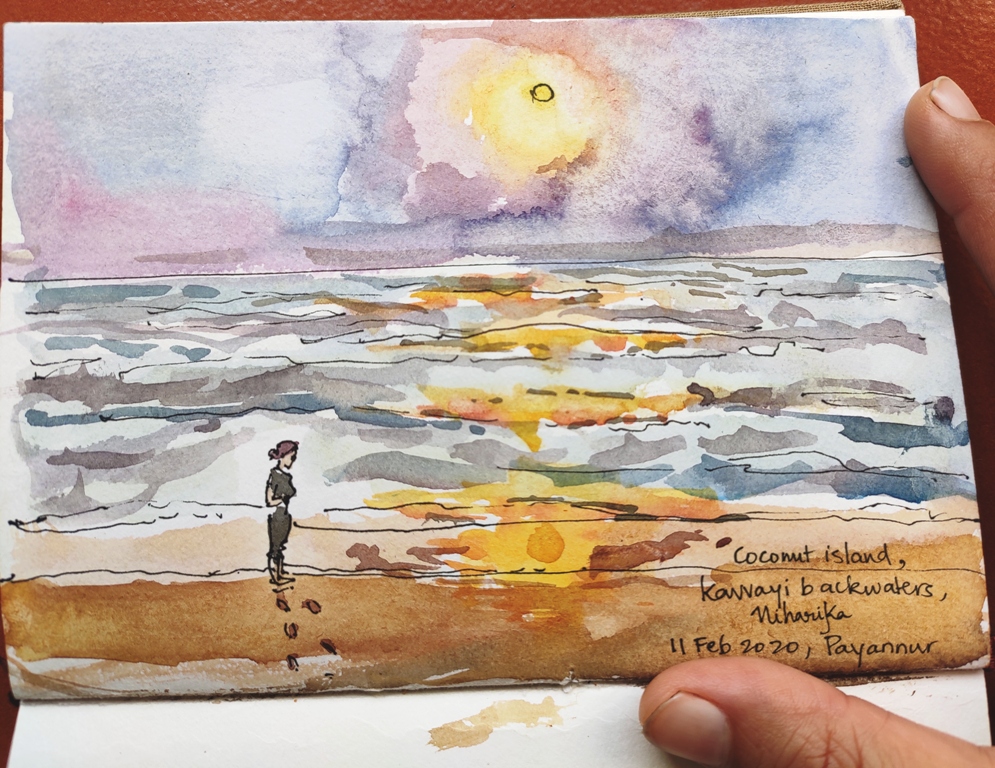
Kavvayi islands - Coconut island - watercolors & sea water :) If I close my eyes, I can smell the sea and see the clear line that separates the Arabian sea from the sky. My sister has skipped on ahead, rolling and tumbling and galloping in the sand with abandon. The local boys that came with us on the boat from the Payannur mainland eye us warily for a while. We three are the only women. I write about this place with hesitation. Because I know it will stop being the pristine spot that it is, the minute more people come to know of it. Because people just cannot refrain from throwing in a plastic bottle here, or a chips packet there - itching, itching to turn everything into their own dirty little dumping ground. So here's where you stop reading and stay home if you plan to litter, strew around beer bottles and act like a hooligan. And here's where you can read on, if you promise to respect the place and leave it untouched. The Kavvayyi backwaters make you un...

Summers in Udupi

Image
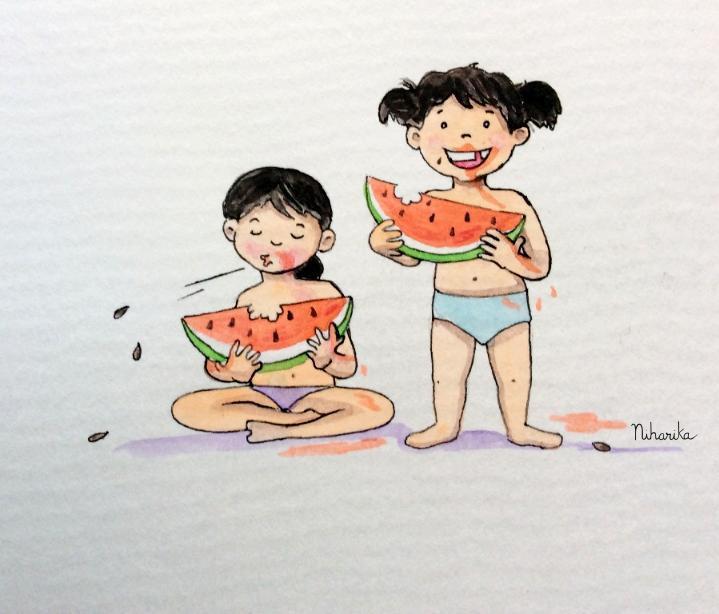
Summers were all about watermelon in Udupi. We - me and my sister, never felt the scorching heat that used to bother the adults around us. It was all about endless days of playing, running wild and whiling away time. We would strip down to our undies and be duly handed slices of  cold watermelon to eat. We would polish them off slowly. The juice trickled down our chins and stained our drawers, but we ate it with abandon. That's my sister spitting out the seeds like a pro : D It was also that time of my childhood which must have been a trial for my parents, now that I think of it. You know the time,  when your  milk teeth are falling out, and you are increasingly difficult, annoying and doing all the socially inappropriate things that are hilarious in retrospect, but not so funny, especially to one's parents at the time. The Dennis the menace years, I would call them :) So go on and find yourself a slice of nostalgia this summer and let's say cheers to those good old...

The elephant in Dubare

Image
On a trip to Mysore, we met this little fella in Dubare - A frisky baby elephant happy to be let loose for a little while. His mahout was a little kid of  about 8 or 9 years and I thought to myself, Well! Isn't this a great pair. They both ran into the Kabini river for bath time accompanied by a horde of tourists  wanting to  'bathe' the baby elephant while he just laid there in the cold water , happy as a lark , making gurgling noises and flapping his ears. I was one of the tourists and I was also happy to give the little one a scrub. I like elephants. As do most people. But I suppose humans liking them is not a very good thing for elephants themselves. There is a lot of cruelty involved in making them ' human - friendly'. Have you visited the Mysore Dasara and seen the elephant parade? Or seen an elephant in South Indian temples? And admired them because they look so mammoth, majestic and grand? And felt affection and warmth for them, accompanied by a lit...

In Thanjavur

Image
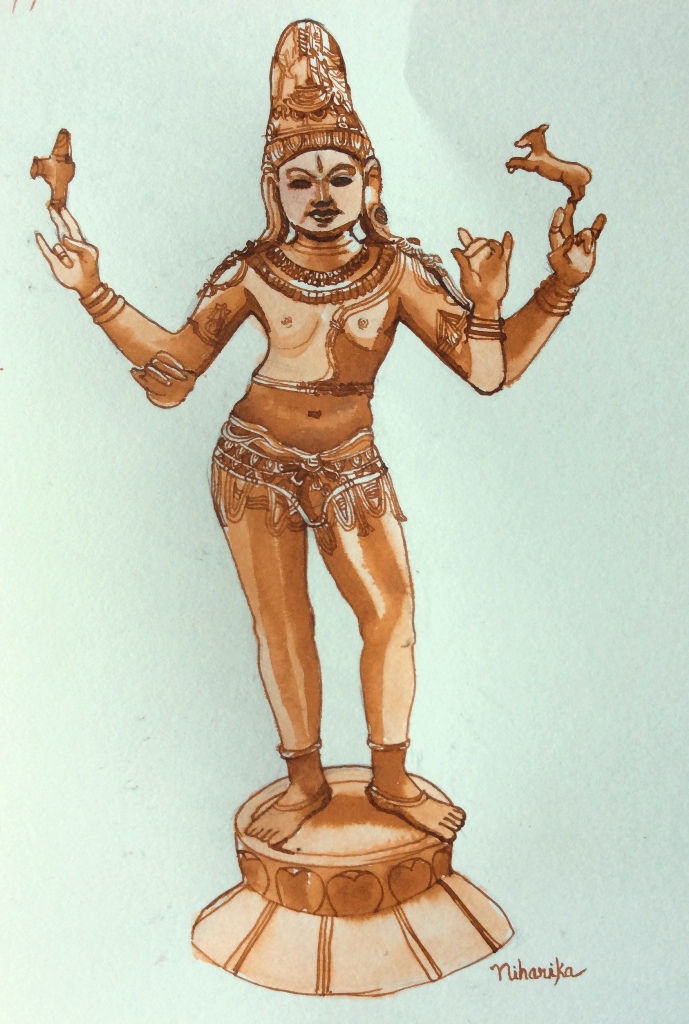
Inside the Thanjavur Maratha Royal complex, in the Royal Palace museum, you will get to see graceful figures in Bronze.  The way they capture the beauty of the human figure with its contours and posture is a treat to see. All the bronze sculptures that are part of the collection have exquisite details.  I especially love the gestures of the hands, every finger elegantly poised, much like they do in stylized theatre or in Classical dance. This sculpture was found in Mayiladuthurai in Tamil nadu. It is named as Thirupurantagar, One of the many names of Lord Shiva. I was amazed to hear of how these sculptures were made. They went through an elaborate process where an intricate wax model was first carved, after which it was covered with clay to form a mould. This was then fired to harden it. The wax melted in the heat leaving only the baked clay intact. The bronze was then melted and poured into this mould. Once it had hardened, the outer clay shell would be shattered. On...

Inside Ashrafi Mahal, Mandu

Image
Near the tower of victory inside Ashrafi Mahal, you can find ruins with beautiful stone carvings. Ashrafi mahal was originally built as a Madrassa and dates back to the time the Khilji Dynasty took over administration in the fortress city of Mandu. The Ashrafi   Mahal must have had wide spacious balconies, but   now there are no traces of that. The outer walls have crumbled and the structure is sky clad. You can witness a beautiful sunset if you come here just before closing time. The flight of stairs takes you through the complex and it has been built so that one can have a direct view of the Jama Masjid across the road. This monument, along with the Jama Masjid and Roopmati’s pavilion are close to the heart of the town with its market and small restaurants and sweetmeat shops. I can only imagine the splendour of this square in the old days, especially on a full moon day. Mandu has a mysteriousness I am yet to find in any other place.

Paddy transplanting in Harlimatha

Image
The Women who bring rice to our plates Paddy transplanting is done exclusively by women in India. And I was interested to find that in Japan, before mechanization, transplanting by hand was exclusively done by women too while the men supervised them. There was an interesting scene in ' Shichinin no samurai'  (Seven Samurai)   by Akira Kurosawa where women stoop in the fields to plant rice in neat rows by hand, while the men sing and draw water for the fields. In Harlimath too, it is a similar scene and men prepare the land and drive the bullocks to get the field ready for the next batch of seedlings. The hired women workers assemble in brightly clad clothes with raincoats and polythene covers, neatly tied scarves topped by a Hale toppi ( A cap fashioned out of Areca leaf), and a collared shirt buttoned up over all this. They look snug and warm. They are probably going to need it because they will wade knee deep in the cold slush of the fields for most of the day wh...

The baobab trees of Mandu

Image
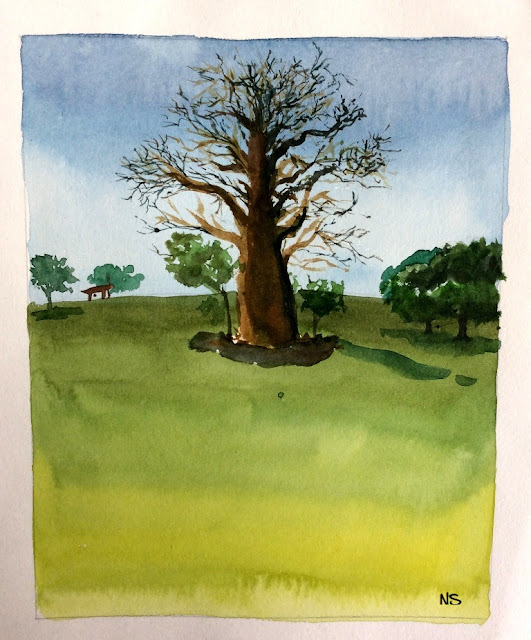
I had heard so much about baobab trees and I finally had a chance to meet one at Mandu. Mandu or Mandav is an ancient fortress town in the Malwa region of Madhya Pradesh. It is a place after my own heart with ruins scattered all over the place making it a town of breathtaking beauty. Much more about Mandu later (I haven’t even begun!) Let’s go back to our baobab tree. Fields with yellow and green dot the path to the village and in the midst stand these curious trees.   They have massive trunks that store water. To me, they look like a cross between a bottle and an elephant – and I find their shape comforting.   These trees are native to Africa. I am curious to know how they got here! Apparently, they are among the most ancient trees on earth.  Locals sell the baobab tree seeds, they are called   Mandu ki imli. They taste like tamarind but have this incredible zing and saltiness. I liked it but not a good idea to eat too much of it (My cavities are tingling at...

The Buddha at Sanchi

Image
Lettering by Malavika Shenoy The Buddha is my favourite trope in art and philosophy. If nothing else, the image of Gautama Buddha in repose with heavy-lidded eyes gives me a vast measure of peace. I have seen many statues of Buddha -all of them remarkably beautiful, but none have made as much of an impression on me as the Buddha at Sanchi. It was my first visit to Madhya Pradesh and also my first experience of the famous M.P sun and its heat waves in summer.   We reached Sanchi at midday -the exact time everything is scorching hot and airless. But I didn’t mind very much because it felt like I had stumbled on treasure. The Stupas at Sanchi are on higher ground from the village and look absolutely stunning in the afternoon sun. I think harsh sunlight brings out the beauty of stone and rock-cut architecture where strong shadows and contrasts create magic wherever light doesn’t reach. A lot of it is not as well-preserved as one would like - Colonial excavations and loca...